
No White Lies - Black Politics And White Power In South Africa, by Kim Heller
No White Lies - Black Politics And White Power In South Africa, by Kim Heller
Couldn't load pickup availability
The author’s views on post-apartheid South Africa are forthright and discomforting. Her opening focus is the Rainbow Nation, a concept she describes as ‘a still-born democracy’, and The New Dawn as ‘dark days indeed’. This is strong political meat that cries out for careful ingestion.
“It is difficult to find a more honest and brutal assessment of South Africa’s new political dispensation. Kim writes that ‘the Rainbow Nation, consummated without revolutionary romance in 1994, has since been unmasked as a deceptive act of seduction to ensure that white power and privilege maintained a choke on the throat of the South African economy’. For those that wallow in ideological confusion and limbo, these articles shoold serve as an antidote to the emasculation of the South African revolution. For now, black politics is entangled in apartheid thinking, with no possibility of escaping colonial entrapment” – Professor Sipho Seepe
“Kim is one of the few political commentators who has had the courage to call out white South Africans for paying lip service to the project that we should all be seized with – which is to uproot the vestiges of colonialism and apartheid which continue to negatively affect so many in South Africa. Kim’s work is important because it exposes how the government of the day, even though black, continues to pander to the interests of the dominant white minority” – Phakamile Hlubi-Majola
Share
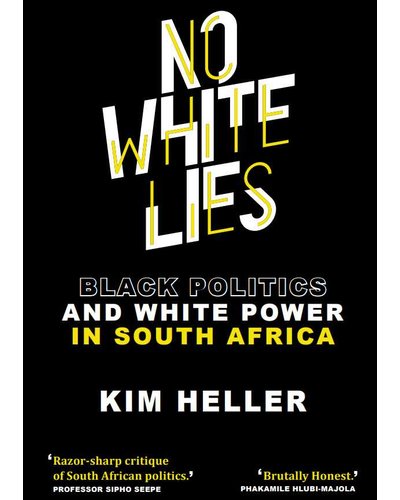
No White Lies: Black Politics and White Power in South Africa advertises itself as a bold confrontation with structural racism and enduring white privilege. In reality, it resembles a series of ideological salvos more than a disciplined political analysis. Compiled from opinion columns, the work favors shock and moral certainty over sustained argument, frequently substituting evidence with broad ethical pronouncements.
Heller’s core thesis is that the “Rainbow Nation” is merely cosmetic, concealing the uninterrupted rule of white power. While this is a legitimate and necessary line of inquiry, the book shows little patience for complexity. Social class, institutional design, global economic forces, and the shortcomings of post-apartheid leadership are reduced to a single culprit: whiteness. The outcome is a narrative driven by intensity rather than insight, closer to exhortation than investigation.
The author’s public political affiliations loom large over the text. Her open support for the EFF and its rhetoric informs the book’s combative posture. She promotes the view that all white South Africans, including those born after 1994, are morally obliged to apologize to black people, effectively converting historical responsibility into racial inheritance. Detractors contend that this transforms accountability into essentialism, weakening the moral force of genuine anti-racist critique.
Stylistically, the prose is forceful and unrestrained, but it often slips into generalized antagonism toward white South Africans as a category. Instead of dissecting systems of domination with care, it personalizes blame, erasing the distinction between analyzing privilege and disparaging people. Readers hoping for nuanced discussion of reform, policy, or economic justice will encounter mostly slogans and outrage.
In the end, No White Lies functions less as a study of South Africa’s stalled transformation and more as an affirmation of a particular ideological stance. It will resonate with those already convinced by its premises, but readers searching for balanced, probing insight into race and power are likely to find it divisive, oversimplified, and rhetorically severe. The deeper irony is that indignation, however understandable, cannot substitute for careful and credible political reasoning.
This book is poor left wing journalism, the argument that is put forward by the author is that White People should be dispossed of what they have worked hard for in favour of Redress. Very simplistic view of the world, Kim is what is know as a white saviour, and her biased communist views can be disgarded as quick as this book will be